Office of the NSW Anti-Slavery Commissioner (NSW OASC) GRS Model Tender Clauses – Streamlined
Supports NSW public buyers’ compliance w/ modern slavery due diligence obligations. Provides basis to identify residual risks associated w/ suppliers & assess effectiveness of controls. Designed to be adapted for consistency w/ tender docs.
 GRS Model Tender Clause – Streamlined
December 2023
Explanatory Note: These GRS Model Tender Clauses on modern slavery have been prepared by the Office of the NSW Anti-slavery Commissioner. The GRS Model Tender Clauses are intended as a resource for NSW public entities and should be read in conjunction with the NSW Anti-slavery Commissioner’s Guidance on Reasonable Steps. The concepts of ‘Heightened’, ‘Standard’, ‘Light’ and ‘Minimal’ Due Diligence procurements are set out in that Guidance.
Drafting Note: These tender clauses and schedule are designed to be used in conjunction with the NSW Anti-slavery Commissioner’s Guidance on Reasonable Steps (‘GRS’) and the NSW Anti-slavery Commissioner’s Model Contract Clauses on modern slavery. These clauses should be used where the reporting entity determines, in conformance with the GRS, that the procurement requires Light, Minimal and Standard Due Diligence. These tender clauses and schedule assist the reporting entity to discharge its statutory responsibility to take reasonable steps to ensure it is not procuring goods or services that are products of modern slavery. They do this by facilitating effective due diligence by the Buyer on the Tenderer. In these clauses the reporting entity is referred to as the ‘Buyer’ and the bidders are referred to as the ‘Tenderer’. The tender document is referred to as the ‘Tender’. This terminology should be adjusted for consistency with the tender documents in which these clauses will be inserted.
Tender Clause
1 Modern Slavery
1.1 Definitions
Modern Slavery
(a) means any conduct that constitutes or would constitute a modern slavery offence, being an offense described in Schedule 2 of the Modern Slavery Act 2018 (NSW), or an offence of attempting or incitement to commit an offence described in Schedule 2 of the Modern Slavery Act 2018 (NSW).
(b) includes any conduct that constitutes or would constitute an offence under any of the Modern Slavery Laws as amended from time to time, including an offence of attempting or incitement to commit such an offence; and
(c) includes conduct engaged in elsewhere than in New South Wales that, if it occurred in New South Wales, would constitute a modern slavery offence under paragraphs (a) or (b).
Modern Slavery Laws means:
(a) the Modern Slavery Act 2018 (Cth);
(b) the Modern Slavery Act 2018 (NSW);
(c) Divisions 270 and 271 of the Commonwealth Criminal Code;
(d) section 176(1A) of the Public Works and Procurement Act 1912 (NSW);
(e) section 438ZE of the Local Government Act 1993 (NSW); and
(f) any other laws, regulations, codes and international conventions aimed at combatting modern slavery, forced labour or human trafficking, from time to time in force in or ratified by Australia and, where relevant, in or by other jurisdictions in which the parties operate, each as amended from time to time.
reasonable steps means those steps that are reasonable in the circumstances to prevent, identify, mitigate and remedy modern slavery. In assessing whether steps are reasonable, the parties may refer to the NSW Anti-slavery Commissioner’s Guidance on Reasonable Steps and related information and resources published by the Anti-slavery Commissioner.
1.2 Modern Slavery Contract Clauses
By lodging a Tender, the Tenderer agrees that, if it is the successful Tenderer, it may be required to comply with modern slavery contract clauses in the contract entered into with the Buyer.
1.3 Price By submitting a Tender, the Tenderer acknowledges and agrees that if it is awarded the Tender based on the pricing or compensation information it has submitted in its tender documents, this submitted pricing or compensation will allow it to perform the contract without causing or contributing to modern slavery, and to provide or enable an effective remedy to any modern slavery it does cause or to which it does contribute.
1.4 Evaluation Tenders will be evaluated to determine the Tender which represents the best value for money to the Buyer. In considering the Tender, the Buyer will apply the following evaluation criteria:
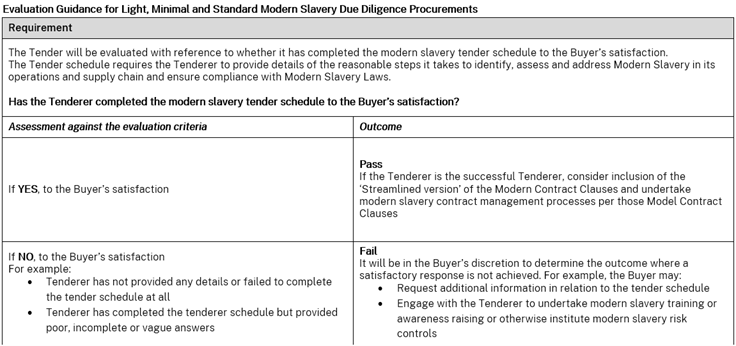
Modern slavery (pass/fail; no weighting): The Tender will be evaluated with reference to whether it has completed the modern slavery tender schedule to the Buyer’s satisfaction.
[Drafting note: this clause is intended to supplement the existing evaluation clause in the tender documents and should be adjusted for consistency with the tender documents in which these clauses will be inserted.]
Tender Schedule
Question: The Tenderer is to provide details of the reasonable steps it takes to identify, assess and address Modern Slavery in its operations and supply chain and ensure compliance with Modern Slavery Laws.
Note: reasonable steps means those steps that are reasonable in the circumstances to prevent, identify, mitigate and remedy modern slavery. In answering the tender schedule, the Tender may refer to the NSW Anti-slavery Commissioner’s Guidance on Reasonable Steps and related information and resources published by the ASC.
Answer: [Tenderer to provide details below]
Guidance on use General Guidance Modern slavery tender clauses and schedules should be proportionate and not impose any unnecessary burdens that would deter a wide diversity of suppliers, including small and medium sized enterprises (SMEs) and Aboriginal and Torres Strait Islander entities from bidding for government contracts. The model tender clauses should be adjusted for consistency with the tender documents, including in particular the evaluation clauses. Buyers should refer to the NSW Anti-slavery Commissioner’s Guidance on Reasonable Steps (‘GRS’) to inform their assessment of Tenderer’s responses.
Use and adaption of MTCs
For Light, Minimal and Standard modern slavery due diligence procurements, the MTCs, including the recommended evaluation criteria clause, are not mandatory. The MTCs, including the evaluation clause, are intended to supplement the existing clauses in the tender documents, and should be adjusted for consistency with the tender documents in which the clauses will be inserted.
Evaluation Criteria
For Light, Minimal and Standard Due Diligence procurements, a pass/fail tender modern slavery tender schedule is recommended that 1) allows Buyers discretion to consider whether the response is satisfactory and the outcome where a satisfactory response is not achieved and 2) still encourages Tenderers to provide modern slavery information, without burdening them with a lengthy supplier self-assessment questionnaire. It will be in the Buyer’s discretion to consider whether the response is satisfactory and the outcome where a satisfactory response is not achieved.
Evaluation Guidance
See below example. The evaluation of the modern slavery evaluation criteria must be consistent with the evaluation process set out in the tender documents.
| Clause Type | Social |
| Jurisdiction | New South Wales (NSW), Australia |
| Industry | Multiple / cross-industry |
| Focus Area | Buy-side |
| Scope | both |
| Contract Type | Master Services Agreement (MSA), Consulting Services Agreement, IT Outsourcing Agreement, Joint Venture Agreement, Partnership Agreement, Service Level Agreement (SLA), Data Processing Agreement (DPA), Facilities Management Agreement, Research and Development Agreement, Construction Agreement, Maintenance Agreement, Purchase Agreement / Order, Sales Contract, Statement of Work (SOW) |
| Relevant UNSDGs | Goal 8: Decent Work and Economic Growth, Goal 9: Industry, Innovation, and Infrastructure, Goal 10: Reduced Inequality, Goal 12: Responsible Consumption and Production, Goal 16: Peace, Justice, and Strong Institutions, Goal 17: Partnerships for the Goals |
| Connecting Clauses | Yes |
*Please note that there are two versions of this clause available in the Sustainability Clause Library – this streamlined version and an additional heightened version which you can find here.